An NP Digital study of 565 marketers found that 47% encounter AI inaccuracies several times per week. Over 70% spend hours fact-checking AI output. And 36.5% admitted that hallucinated or incorrect AI content has been published publicly — false facts, broken source links, or inappropriate language that made it past review.
These aren't bad marketers. They're using AI tools that weren't built for marketing analysis.
The garbage-in problem
When you ask ChatGPT "analyze my marketing performance," it has no data to analyze. So it generates plausible-sounding advice based on general training data: "Consider A/B testing your landing pages" and "Focus on high-intent keywords." Technically correct. Practically useless. It doesn't know your conversion rate, your traffic sources, or your competitive landscape.
When you connect an MCP server to give your AI access to GA4, things get worse in a different way. Now the AI has data — but it's raw API output. Hundreds of rows of dimension values and metric values, formatted for machines, not marketers.
The AI sees "value": "0.34219" and has to figure out that's a bounce rate by counting its position in the metric array and cross-referencing the header. It sees "20260218" and has to parse that as February 18, 2026. It sees 247 rows of this and has to decide what matters.
Most of the time, it just reformats the data into a table and adds a generic summary like "organic traffic shows positive trends." That's not analysis. That's a formatting exercise.
Why raw data leads to bad advice
There are three specific failure modes when AI tries to analyze raw marketing data:
1. No domain context
A bounce rate of 85% on a blog post is normal — people read the article and leave. A bounce rate of 85% on a checkout page is a crisis. The AI doesn't know the difference unless someone tells it.
A 3% conversion rate might be excellent for a B2B SaaS landing page and terrible for a branded search campaign. Without knowing the page type, the industry, and the traffic source, the AI can't distinguish "good" from "bad."
Raw data tools give the AI numbers without context. The AI fills in context from its training data, which is generic at best and wrong at worst.
2. No anomaly detection
When your pricing page bounce rate jumps from 38% to 47% in a week, that's worth investigating. But in a sea of 247 rows of data, the AI is just as likely to highlight that your blog traffic grew 2% (boring, expected) as it is to flag the bounce rate spike (unexpected, actionable).
Without domain expertise guiding what matters, AI defaults to "sort by biggest number" or "highlight anything that changed." That surfaces noise, not signal.
3. No cross-source correlation
The most valuable marketing insights live between data sources. "Conversions dropped because the traffic mix shifted from transactional to informational" — that requires GA4 conversion data AND Search Console query data AND Google Ads campaign history.
Raw data tools give you one source at a time. By the time you've asked three separate questions to three separate MCP servers, the AI may have lost the GA4 context from its context window. And even if it remembers, correlating raw data across different formats, time granularities, and metric definitions is error-prone.
The Salesforce finding
Salesforce's 2026 State of Marketing report surveyed 4,450 marketing professionals across four regions. The finding: 75% of marketers have adopted AI — but 98% reported at least one data-related barrier preventing them from using AI for personalization effectively.
The top barriers: data silos (data spread across disconnected platforms), too much data (volume without synthesis), and poor data quality (inconsistent formats, stale information).
In other words: almost every marketer who's adopted AI has run into the same wall. The AI is capable. The data is available. But the connection between them is broken.
What "good" looks like
The fix isn't better AI models. Claude, GPT-4, and Gemini are all capable of excellent marketing analysis — when given the right input. The fix is what happens between your data and the AI.
Domain context built in. The system should know that a 7.5% conversion rate on a product page is significantly above the typical 2-4% range. It should know that a 23% bounce rate increase on a pricing page is worth flagging. This context shouldn't come from the AI's general training — it should be encoded in the analysis layer.
Anomaly detection before synthesis. Before the AI sees the data, the system should identify what's unusual. A 2% traffic increase is expected. A 23% bounce rate spike is an anomaly. Pre-flagging anomalies focuses the AI's attention on what matters.
Cross-source correlation by default. The question "why did conversions drop?" should automatically pull conversion data, traffic quality data, and campaign change data — not require three separate queries and manual correlation.
Recommendations, not just observations. "Organic traffic increased 12%" is an observation. "Create supporting content for your top-ranking page to consolidate the topic cluster" is a recommendation. The difference is domain expertise.
The accuracy gap
DemandScience's 2026 report found that two-thirds of marketing leaders say their dashboards "sometimes, often, or very often show success that fails to translate into revenue." The dashboards aren't lying — they're showing real metrics. But metrics without context create a false picture.
AI tools that just reformat dashboard data inherit this problem. If your GA4 dashboard shows 10,000 sessions as a success metric, an AI tool that reads GA4 will report "strong traffic growth." It won't tell you that 80% of those sessions are informational queries with a 0.1% conversion rate.
The path from data to good advice requires a layer of intelligence between the raw API and the AI. That layer needs to understand marketing, not just data formats.
What to look for
If your AI is giving you generic or incorrect marketing advice, ask these questions:
-
Is it analyzing your actual data, or generating advice from training data? If there's no data connection, every recommendation is a guess.
-
Is it getting raw API output, or structured analysis? If the response includes metric type annotations and property quota objects, it's getting raw data and doing its best to interpret it.
-
Does it flag anomalies, or just report numbers? Look for responses that say "this is unusual" or "this warrants investigation." If every metric is treated with equal importance, anomaly detection is missing.
-
Does it correlate across sources? If answering "why did conversions drop?" requires three separate queries and you manually connecting the dots, cross-source intelligence is missing.
-
Are the recommendations specific to your data? "A/B test your landing pages" is generic. "Your /pricing page bounce rate spiked 23% — consider testing benefit-focused hero copy vs. the current feature list" is specific.
What bad advice actually costs
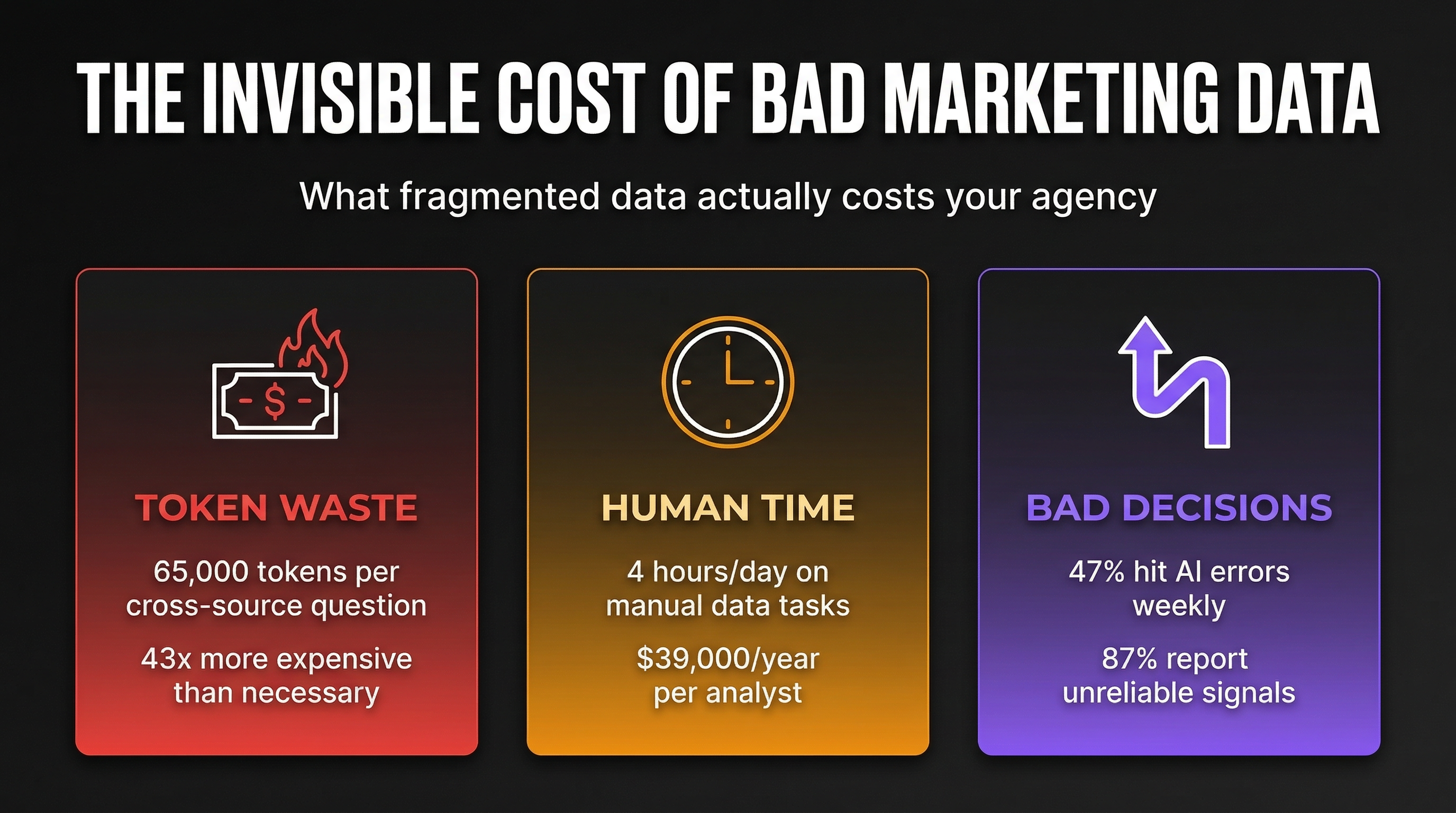
The accuracy gap isn't just annoying — it has measurable downstream costs that most teams never attribute to data quality.
Round-trip multiplication. When your AI can only access one data source at a time, answering "why did conversions drop?" requires querying GA4 (25,000 tokens), then Search Console (15,000 tokens), then Google Ads (20,000 tokens), then asking the AI to synthesize all three (5,000 tokens). That's 65,000 tokens for one question. A single cross-source query with synthesized data: 1,500 tokens. The same answer, 43x cheaper — and higher quality because the AI doesn't have to correlate raw data from three separate conversations.
Human time. HubSpot's 2024 State of Marketing report found that marketers spend an average of 4 hours per day on manual, administrative, and operational tasks. For agencies, industry benchmarks put reporting overhead at 15-20 hours per week per reporting cycle — logging into platforms, switching between client accounts, pulling data, compiling reports. At $50/hour, that's $750/week before a single recommendation is written.
Bad decisions from fragmented data. DemandScience's 2026 report found that 87% of organizations report their marketing investments yield "unreliable or inflated signals." Only 26% of intent signals convert to qualified opportunities. A campaign that looks successful in Google Ads (platform-reported ROAS of 4.8x) but actually returns 3.1x when correlated with real revenue data means you're over-investing based on inflated numbers.
For a typical agency with 20 clients, these invisible costs add up to $3,000-50,000+ per month — token waste, analyst time, and misallocated budget from fragmented data. The "free" approach costs orders of magnitude more than any tool subscription. The cost is just hidden across different budget lines.
The fix
The gap between "AI for marketing" that works and "AI for marketing" that frustrates isn't the model. It's the data pipeline feeding it.